
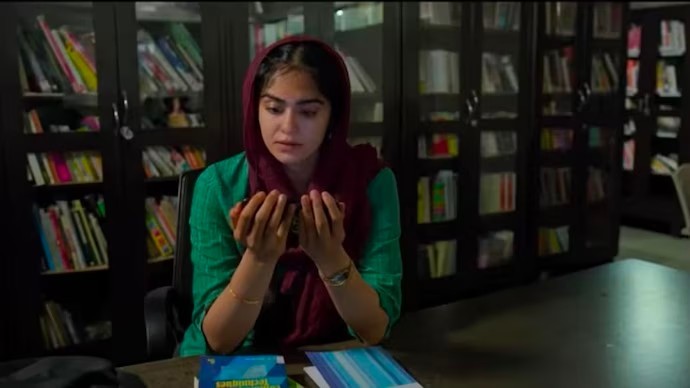













Synopsis: “The Kerala Story” portrays the journeys of three young women from different regions of Kerala, with a particular emphasis on Shalini’s story. Shalini is abducted and forcibly converted to Islam, subsequently falling victim to radicalization and being coerced into joining ISIS as a terrorist.
Review: “The Kerala Story” revolves around the alleged instances of radicalization and conversion of young Hindu women to Islam in Kerala, followed by their forced involvement with ISIS. The film claims to depict the true story of three young girls from various parts of Kerala.
The narrative of “The Kerala Story” unfolds within an interrogation room, where Shalini (Adah Sharma) recounts the harrowing and tragic events of her past, explaining the reasons behind her current crisis. The backstory revolves around four college students enrolled in a Nursing School in Kasargod, Kerala. The perspective is primarily that of Shalini, who shares a deep bond with her roommates Gitanjali (Siddhi Idnani), Nimah (Yogita Bihani), and Asifa (Sonia Balani). Unbeknownst to the others, Asifa harbors a secret agenda of exposing and converting her roommates to Islam. With the help of male associates from outside, she ensures the radicalization and indoctrination of the girls through the use of hallucinogenic drugs. As Shalini becomes pregnant, she is forced to marry someone other than the person who impregnated her, ultimately embarking on a treacherous journey to Syria via Pakistan and Afghanistan.
Adah Sharma delivers a powerful and emotionally stirring portrayal of Shalini, who eventually adopts the name Fatima. Her dedication in mastering the Malayali accent is evident on-screen. While many of the actors, such as Yogita Bihani, Sonia Balani, and Siddhi Idnani, are newcomers, they give their best performances to breathe life into their characters. Director Sudipto Sen has chosen a sensitive and complex subject, and the treatment given to the film makes it a challenging watch with several disturbing scenes, moments, and dialogues.
The director successfully creates moments that evoke a natural unease among viewers. Dealing with sensitive subject matters can be a delicate balancing act, but Sudipto appears to handle it with finesse. Prasantanu Mohaptra excels in capturing the Afghan and Afghanistan-Pakistan border scenes. However, the film falls short in terms of its background score, which tends to overpower the narrative and become a distraction.
The hostel scenes featuring the girls are well-executed, but there are also moments in the film that feel dull and uninteresting, particularly during Asifa’s attempts to brainwash and radicalize Shalini. Caution must be exercised during the extremely disturbing rape scene in the ISIS slave camp.
At times, the film leans more towards being an educational exploration of radicalization rather than pure entertainment for the audience. It goes to extreme lengths to convey its message, which may unsettle viewers from various communities in our country. After watching “The Kerala Story,” numerous questions about the current state of the nation may linger in your mind. This thought-provoking film leaves a disturbing impact and is sure to resonate with its audience.


